Study the ocean up close with Ä¢¹½¶ÌÊÓƵ’s Marine Science degree, offered as a Bachelor of Arts or Bachelor of Science. This interdisciplinary program explores marine biology and oceanography while preparing students to understand and protect coastal environments near the Jacques Cousteau National Estuarine Research Reserve.
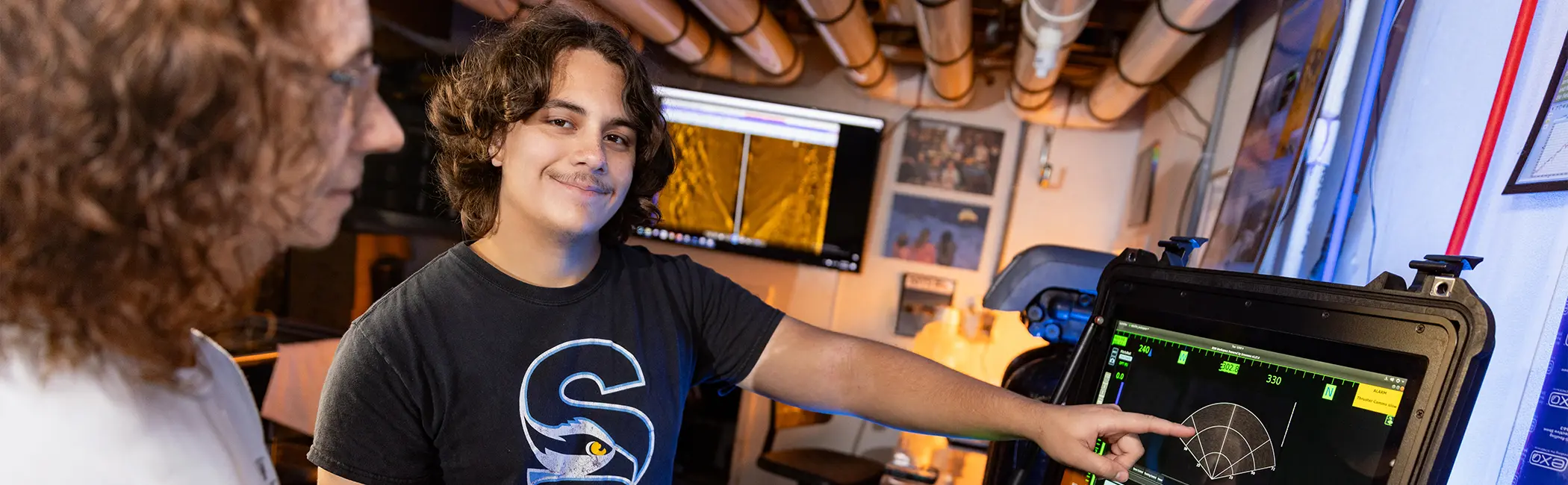
Students gain skills through fieldwork, lab research, and data analysis using tools like sonar and GIS mapping. Coursework covers marine ecosystems, ocean chemistry, and coastal processes, with options for a broader or science-focused path. Internships and research projects prepare graduates for careers in marine science, conservation, and environmental fields.
Where Science Meets the Coast
What can you do with a Marine Science degree from Ä¢¹½¶ÌÊÓƵ?
Graduates pursue careers in marine biology, oceanography, coastal resource management, and environmental consulting. Many work with federal and state agencies, nonprofit conservation organizations, or private firms focused on marine ecosystems, water quality, and fisheries management. Some students also continue into graduate programs in marine science or related environmental fields.
How hands-on is the Marine Science program at Ä¢¹½¶ÌÊÓƵ?
Hands-on learning is central to the program. Students participate in fieldwork, estuarine sampling, and marine research using vessels and equipment at the Marine Field Station. Activities include sediment analysis, water quality testing, and oceanographic data collection, helping students build real-world marine science and field research skills.
What areas of marine science can students study?
Students can focus on marine biology or oceanography while exploring topics such as marine ecology, coastal processes, marine chemistry, and fisheries science. Coursework also includes GIS mapping, data analysis, and environmental monitoring, allowing students to develop specialized interests within marine and coastal science.
What makes Ä¢¹½¶ÌÊÓƵ’s coastal location unique for Marine Science students?
Ä¢¹½¶ÌÊÓƵ’s proximity to the Mullica River-Great Bay estuary provides direct access to a living laboratory for studying coastal ecosystems, hydrology, and marine habitats. Students regularly conduct field studies in this environment, gaining experience with estuarine systems and coastal research methods.
Do Marine Science students conduct research as undergraduates?
Yes, students often collaborate with faculty on marine science research projects and may design independent studies. Many present their findings at undergraduate research symposia and regional scientific conferences, building experience in scientific communication, data interpretation, and field-based research.
Program Faculty

Anna Pfeiffer-Herbert

Camilla Alves Souto

Gordan Grguric
Gordan Grguric
Associate Professor of Marine Science

BIOGRAPHY
- Principal investigator of a bromate modeling project in a closed seawater system
- researched inorganic ozonation by-products in seawater
- collaborated with scientific and management personnel at The Living Seas aquarium to maintain the chemical balances in the system
- analyzed interstitial water from estuarine sediments for a variety of parameters
- produced computer models for maintaining (1) seawater ratios of major ions, and (2) pH and alkalinity in artificial seawater systems
- analyzing seawater chemistry in a variety of closed systems
- conducting studies on bay water chemistry in Great Bay, New Jersey
EDUCATION
Ph.D., M.S., Florida Institute of Technology
B.S., Lehigh University
AREAS OF EXPERTISE
Seawater aquarium chemistry, redox processes, interstitial water, physical and chemical modeling of closed seawater systems.
COURSES TAUGHT
Program teaching: Introduction to Oceanography, Oceanography II, Marine Chemistry
Laboratory and Analysis of Seawater and Sediments
General Studies teaching: The World Ocean and Our Living Planet
RESEARCH INTERESTS
I lead a research group in Marine Chemistry. The basis of our work is chemical analysis of samples from a variety of marine environments. Our laboratory is located at the Marine Field Station. Ongoing projects include measurements of salinity (chlorinity), pH, alkalinity and major seawater ions for the local estuarine waters. Field work in Great Bay includes sampling of sediments and analysis of sediment pore water for sulfide, sulfate, ammonia, pH, redox potential and other parameters.
PUBLICATIONS
Grguric G, Komas J. A. and Gainor L. A. (1999) Differences in major ions composition of artificial seawater from aquarium tanks at the New Jersey State Aquarium. Aquarium Sciences and Conservation 2, 145-159.
Grguric G., Wetmore S. S. and Fournier R. W. (2000) Biological denitrification in a closed seawater system. Chemosphere 40, 549-555.
Grguric G., Sondey C. J. and DuVall B. M. (2000) Carbon and nitrogen fluxes in a closed seawater facility. The Science of the Total Environment 247, 57-69.
Grguric G. (2002) Denitrification as a model chemical process. Journal of Chemical Education 79(2), 179-182.
Kupchik M. J. and Grguric G. (2005) Interstitial water nutrients at several sites in Great Bay, New Jersey. American Society for Limnology and Oceanography - Aquatic Sciences Meeting.
Kaba J. R. and Grguric G. (2008) Major ion concentrations versus chlorinity in a low tide surface transect, Great Bay Estuary, New Jersey. Atlantic Estuarine Research Symposium.
Troselj M., Matetic M. and Grguric G. (2009) Building an expert system module for World Ocean thermocline analysis: thermocline qualitative modeling. MIPRO 2009 Conference.
Vera R., Valenti J. L. and Grguric G. (2014) Lateral and vertical variations in inorganic parameters throughout Mullica River-Great Bay Estuary. New Jersey Water Environment Association Conference.

Susanne Moskalski
Susanne Moskalski
Associate Professor of Marine Science
BIOGRAPHY

Dr. Moskalski earned her M.S. and Ph.D. degrees from the University of Delaware. Her dissertation research was about factors influencing sediment transport in the St. Jones River in Delaware. She completed a post-doctoral research position at the University of South Carolina studying the effects of rainfall on sediment and trace metal mobilization in salt marshes. Her most recent post prior to Ä¢¹½¶ÌÊÓƵ was a post-doctoral fellowship at the Université de Bretagne Occidentale/Institut Universitaire Européen de la Mer in Brest, France, during which she studied sediment flux and decadal-scale change in a small macrotidal estuary.
Website/CV:
EDUCATION
PhD Marine Studies/Geological Oceanography, The University of Delaware
M.S. Geology, The University of Delaware
B.S. Earth Sciences, The Pennsylvania State University
AREAS OF EXPERTISE
Clastic sedimentology, sedimentary and surficial processes in marshes and estuaries, sediment flux, deposition/erosion rates and patterns, storm effects, human impacts, time series analysis.
COURSES TAUGHT
GEOL 2110 Marine Geology
GEOL 2102 Historical Geology
MARS 3305 Coastal Processes
GEOL 3231 Sedimentology and Stratigraphy
GNM 2129 Ocean Planet: Where the River Meets the Sea
PUBLICATIONS
GEOL 2110 Marine Geology
GEOL 2102 Historical Geology
MARS 3305 Coastal Processes
GEOL 3231 Sedimentology and Stratigraphy
GNM 2129 Ocean Planet: Where the River Meets the Sea

Mark Sullivan
Mark Sullivan
Professor of Marine Science
BIOGRAPHY

Dr. Mark Sullivan received his M.S. degree in Marine Environmental Science from SUNY Stony Brook and a Ph.D. in Marine Biology and Fisheries from the University of Miami Rosenstiel School of Marine and Atmospheric Science. His dissertation research investigated the effects of mobile fishing gear on recently settled yellowtail flounder relative to natural processes on the New York Bight continental shelf. He completed a post-doctoral position at the Rutgers University Marine Field Station examining the linkages between supply and environmental variability for American eel glass eels and summer flounder larvae along the U.S. mid-Atlantic coast. Mark is currently an Associate Professor in the Marine Science program at Ä¢¹½¶ÌÊÓƵ where he continues to work on research themes related to locally and federally managed fisheries.
EDUCATION
Ph.D., University of Miami, Marine Biology and Fisheries
M.S., SUNY Stony Brook, Marine Environmental Science
B.S., Tulane University, Ecology, Evolution, Organismal Biology
AREAS OF EXPERTISE
Ichthyology, ecology of early stage fishes in estuarine and continental shelf ecosystems, anthropogenic stressors as sources of coastal marine ecosystem variability, cooperative fisheries research.
COURSES TAUGHT
MARS 2201 Introduction to Marine Biology (w/lab)
MARS/BIOL 3340 Introduction to Ichthyology (w/lab)
MARS 3307 Fisheries Science and Management (w/lab)
MARS 1100 Survey of Ocean Life
GNM 1123 Fisheries in Crisis
GNM 2142 Sharks: Myth and Reality
ENSC 5013 Field Methods
ENSC 5320 Ocean Sustainability
RESEARCH INTERESTS
His research broadly focuses on the role of larger-scale phenomena (fishing activity, regional oceanography, climate change) as sources of variability for marine and estuarine species, primarily fishes (yellowtail flounder, American eel, summer flounder, blue crab, etc.). He employs a variety of techniques (collections in the field, time series analysis, experimental manipulations, marine technology) in order to gain a better understanding of the relative contributions of these impacts to local ecosystems. This work by nature is highly collaborative – he enjoys working with a talented and diverse group of colleagues and stakeholders both inside and outside of Ä¢¹½¶ÌÊÓƵ. His long-term goal is to implement the above themes into a research program that (1) helps fishery managers make informed decisions with respect to commercially and recreationally important species and (2) encourages cooperative and rewarding partnerships between fishery scientists, stakeholders, and managers alike.
PUBLICATIONS
Able, K., T. Grothues, M. Shaw, S. VanMorter, M. Sullivan, and D. Ambrose. 2020. Alewife (Alosa pseudoharengus) spawning and nursery areas in a sentinel estuary: spatial and temporal patterns. Environmental Biology of Fishes 103:1419-1436.
Sullivan, M., S. Evert, P. Straub, M. Reding, N. Robinson, E. Zimmermann, and D. Ambrose. 2019. Identification, recovery, and impact of ghost fishing gear in the Mullica River-Great Bay Estuary (New Jersey, USA): stakeholder-driven restoration for smaller-scale systems. Marine Pollution Bulletin 138:37-48.
Toth, J., S. Evert, E. Zimmermann, M. Sullivan, L. Dotts, K. Able, R. Hagan, and C. Slocum. 2018. Annual residency patterns and diet of Phoca vitulina concolor (Western Atlantic Harbor Seal) in a southern New Jersey estuary. Northeastern Naturalist 25(4): 611–626.
Musumeci, T., K.W. Able, M.C. Sullivan, and J.Smith. 2014. Estuarine predator-prey interactions in the early life history
of two eels (Anguilla rostrata and Conger oceanicus). Environmental Biology of Fishes
97:929-938.
Straub, P.F., S. Evert, T.L. Luke and M.C. Sullivan. 2013. Mapping of artificial reef habitats by side scan sonar and ROV in the northwestern
mid-Atlantic coastal ocean. In: Lang M. and M.D.J. Sayer, eds. Proceedings of the
AAUS/ESDP Curacao Joint International Scientific Diving Symposium, October 24-27,
2013, Curacao. American Academy of Underwater Sciences. Dauphin Island, AL,
pp: 331-338.
Able, K.W., M.C. Sullivan, J.A. Hare, G. Bath-Martin, C. Taylor, and R. H. Hagan. 2011. Larval abundance of
summer flounder (Paralichthys dentatus) as a measure of recruitment and stock status.
Fishery Bulletin (U.S.).109(1):68-78.
Sullivan, M.C., M.J. Wuenschel, and K.W. Able. 2009. Inter- and inter-estuary variability in ingress,
condition, and settlement of the American eel (Anguilla rostrata): Implications for
estimating and understanding recruiting. Journal of Fish Biology (Special Issue: Anguilid
eel biology, conservation, and management) 74:1949-1969.
Sullivan, M.C., K.W. Able, J.A. Hare, and H.J. Walsh. 2006. Anguilla rostrata glass eel ingress
into two U.S. east coast estuaries: Patterns, processes, and implications for adult
abundance. Journal of Fish Biology 69:1081-1101.
Sullivan, M.C., R.K. Cowen, K.W. Able, and M.P. Fahay. 2006. Applying the basin model: Assessing
habitat suitability of young-of-the-year demersal fishes on the New York Bight continental
shelf. Continental Shelf Research 26:1551-1570.
Sullivan, M.C., R.K. Cowen, and B.P. Steves. 2005. Evidence for atmosphere-ocean forcing of yellowtail
flounder (Limanda ferruginea) recruitment in the Middle Atlantic Bight. Fisheries
Oceanography 14:386-399.
Sullivan, M.C., R.K. Cowen, K.W. Able, and M.P. Fahay. 2003. Effects of anthropogenic and natural
disturbance on a recently settled continental flatfish. Marine Ecology Progress Series
260:237-253.
Sullivan, M.C., R.K. Cowen, K.W. Able, and M.P. Fahay. 2000. Spatial scaling of recruitment in
four continental shelf fishes. Marine Ecology Progress Series 207:141-154.

Christine Thompson

Christophe Vieira
Marine Science Adjunct Faculty


Jacalyn Toth Sullivan
Jacalyn Toth Sullivan
Marine Science Adjunct Faculty
EDUCATION
M.S. Ecology and Evolution, Rutgers University
Research Area: New Jersey coastal marine mammals.
COURSES TAUGHT
Marine Mammalogy
This course is a broad overview of the biology of marine mammals. Focuses include
marine mammal evolution and systematics, physiological, anatomical, behavioral and
ecological characteristics that describe major taxa, functional biology, and physiological
adaptations, as well as current threats, management, and conservation of select species.
Local and global perspective on marine mammal population biology are discussed, as
well as widely used research techniques that answer various questions about these
animals.
Marine Mammals and Mankind
This course explores the politics of marine mammal and human interactions from both
a historical and current context, and discusses the role of the media in helping to
shape public opinion. Students learn general biology of marine mammals, their long-standing
role in historic/current human ecology, and their ever-evolving role in culture and
economics. Impacts of controversial practices such as marine mammal captivity, ‘scientific
whaling’, military exercises, and aboriginal customs are explored and debated.
RESEARCH INTERESTS
Marine mammal ecology; anthropogenic impacts on marine mammal biology, behavior, distribution patterns and essential habitat. Dynamics of New Jersey’s seasonal population of bottlenose dolphins and harbor seals; occurrence, movement patterns, stock structure, seasonal site fidelity, and food habits.
RELEVANT SCHOLARSHIP
Toth J., S. Evert, E. Zimmermann, M. Sullivan, L. Dotts, K.W. Able, R. Hagan and C. Slocum.
2018. Annual Residency Patterns and Diet of Phoca vitulina concolor (Western Atlantic
Harbor Seal) in a Southern New Jersey Estuary. Northeastern Naturalist 25(4):611–626
Toth J.L., A.A. Hohn, and K.W. Able. 2011. Defining bottlenose dolphin (Tursiops truncatus)
population units based on environmental, physical, and behavioral characteristics.
Marine Mammal Science DOI: 10.1111/j.1748-7692.2011.00497.x
Toth J.L., A.A. Hohn and K.W. Able. 2011. Patterns of seasonal occurrence, distribution and site fidelity of coastal bottlenose dolphins in southern New Jersey, U.S.A. Marine Mammal Science 27: 94–110
Toth-Brown J. and A.A. Hohn. 2007. Occurrence of the barnacle, Xenobalanus globicipitis, on coastal bottlenose dolphins (Tursiops truncatus) in New Jersey, U.S.A. Crustaceana 80:1271-1279
PRESENTATIONS
(*student co-author)
Toth, J. 2021. An examination of potential impacts of wind farm operations on population dynamics and food habits of the common harbor seal (Phoca vitulina) in southern New Jersey. Accepted for SMM conference West Palm Beach, FL, December 2021
Baier, L.* and Toth, J. 2021. Impacts of wind farm operations on local pinniped populations: A review. Accepted for SMM conference West Palm Beach, FL, December 2021
Collom, K.*, Brown, D. M., DiGiovanni, R., Durham, K., Kopelman, A., Laurino, M., Lomac-MacNair, K.S., Maust-Mohl, M., Montello, M., Platt, T., Rickard, M.E., Schoelkopf, R., Smultea, M., Zoidis, A., Toth, J. 2021. Extended seasonal occurrence of coastal bottlenose dolphins (Tursiops truncatus) in the northern migratory extent of the Mid-Atlantic. Accepted for SMM conference West Palm Beach, FL, December 2021
Toth, J. 2019. Finscan; A glimspe into an almost-great automated fin-matching program. Presented at the ‘Rise of the Machines’ workshop, The World Marine Mammal Conference. December 7-12, 2019. Barcelona, Spain.
Dotts L.*, Toth J., Evert S., Zimmermann E., Sullivan M., Hagan R., Able K., and Slocum C. 2019. Population and Diet of Common Harbor Seals (Phoca vitulina concolor) in a Southern New Jersey Estuary; a Story of Perseverance and Collaboration, Years in the Making! Southeast and mid-Atlantic Marine Mammal Symposium, March 29-31 Washington DC
Toth J., Evert S., Zimmermann E., Sullivan M., Dotts L.*, Able K.W., Hagan R. and Slocum C. 2018. Diet of Common Harbor Seals (Phoca vitulina concolor) in a Southern New Jersey Estuary; A Story of Perseverance and Collaboration, Years in the Making. Atlantic Fisheries Society Annual Meeting. Atlantic City, NJ.
Toth J., Evert S., Zimmermann E., Sullivan M., Dotts L.*, Able K.W., Hagan R. and Slocum
C. 2017. Annual residency patterns and diet of common harbor seals (Phoca vitulina
concolor) in a southern New Jersey estuary.
24th World Biennial Conference on Marine Mammals. October 2017. Halifax, Nova Scotia.
Panyi A*, Toth J. 2015. Xenobalanus Globicipitis: Occurrence patterns and use for stock identification in New Jersey bottlenose dolphins. Biennial Marine Mammal Conference, December 2015, San Francisco CA
O’Neill L*, Toth J. 2015. Occurrence patterns of bottlenose dolphin calves in Cape May, NJ. Biennial Marine Mammal Conference, December 2015, San Francisco CA
Monaghan D.M.*, Toth J.L. 2013. An overview of bottlenose dolphin (Tursiops truncatus) photo-identification
research with the Cape May Whale Watcher. Ä¢¹½¶ÌÊÓƵ College Unified Science Center
opening ceremony, Pomona, NJ.
Ulmke A.H.*, Toth J.L., Able, K.W. 2011. Seasonal variation in harbor seal fish prey in Great Bay, New Jersey.
Rutgers University summer RIOS internship poster presentation. September, New Brunswick,
NJ
Dotts L.J.*, Toth J.L., Tanedo S.J*., Sullivan, M.C., Evert, S.P., Slocum, C.J. 2011. Prey determination and feeding seasonality of the Great Bay Harbor Seal colony. Ä¢¹½¶ÌÊÓƵ College Undergraduate Research Day. April, Pomona, NJ
Tanedo S.A*., Sullivan M.C., Dotts L.J.*, Toth J.L., Evert S.P., Slocum C.J. 2011. Imaging fish otoliths retrieved from seal scat samples; acquisition, identification, and fish length reconstruction. Ä¢¹½¶ÌÊÓƵ College Undergraduate Research Day. April, Pomona, NJ
Program Mission
Mission Vision
Ä¢¹½¶ÌÊÓƵ’s Marine Science Program is dedicated to undergraduate experiences
within a coastal environment, to form ocean-literate citizens.
Mission Statement
The mission of the Marine Science Program at Ä¢¹½¶ÌÊÓƵ is to promote curiosity and critical thinking through quality education and hands-on experiences both in and out of the classroom. Students will develop intellectually, personally, and professionally within the small class setting, using cutting-edge technology to apply themselves to real-life scenarios within the marine biology and oceanography career fields.
Student & Alumni Highlights
A Summer Filled With Unforgettable Experiences
 The summer of 2024 was a time of unforgettable moments that marine biology major Dylan
Meier '26 will never forget. Not only did he participate in a prestigious 10-week
internship at the Smithsonian's National Museum of Natural History, Dylan also traveled
to the Canary Islands to present his research on echinoderms at the 17th International
Echinoderm Conference & 2nd International Hemichordate Meeting.
The summer of 2024 was a time of unforgettable moments that marine biology major Dylan
Meier '26 will never forget. Not only did he participate in a prestigious 10-week
internship at the Smithsonian's National Museum of Natural History, Dylan also traveled
to the Canary Islands to present his research on echinoderms at the 17th International
Echinoderm Conference & 2nd International Hemichordate Meeting.Learn more about Meier in The Essential Elements article From Ä¢¹½¶ÌÊÓƵ to the Smithsonian: A Marine Science Student's Incredible Journey into the Field of Taxonomy.
Career Success
Graduates of the Marine Science program seek employment directly with their B.A. or B.S. degrees, or go on to graduate school to work for M.S. or Ph.D. degrees. There are a number of employment opportunities in this field, both in the private and public sectors. Students concentrating in Oceanography, and those taking additional electives in marine geology, marine technology, and underwater surveying, should do well in an increasingly quantitative field.
All Marine Science students are required to take a 1-credit seminar course that prepares them for successful careers after graduation. Regardless of area of interest, undergraduate students who seek additional hands-on experiences outside of the classroom tend to flourish at the next level.
Career Information
Ä¢¹½¶ÌÊÓƵ graduates in Marine Science have been very successful in obtaining entry-level
positions in their field with local, state, and federal agencies. Such positions have
involved laboratory work, fieldwork on marine habitats, data analysis, K-12 and public
education, and law enforcement. Some have gone on to consulting jobs with private
firms, while others have entered postgraduate study at major universities.
{{ studyArea.title }}
{{ studyArea.type }}


